An end-to-end AI-ready Azure architecture
Being AI-ready is mostly a data-architecture problem, not a model problem. This is the reference architecture I use to make an Azure estate governed, well-shaped, and ready for retrieval and agents — built on Microsoft Fabric.
The requirement this answers
“Design an end-to-end, production-grade Azure architecture that is ready for AI”
Make the data estate governed and well-shaped first; the AI layer is only as good as the Gold data and the lineage beneath it.
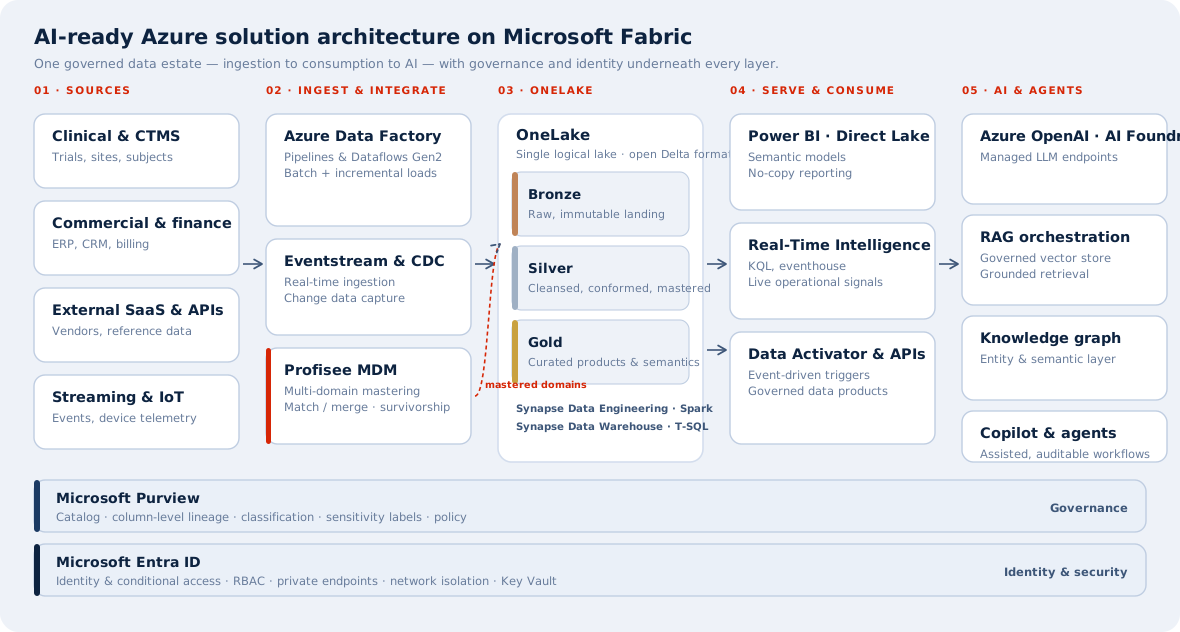
One estate, not a pile of services
The failure mode I see most is a stack of disconnected Azure services — a lake here, a warehouse there, a separate catalog, three copies of the same data — that nobody can govern or trace. I standardize on Microsoft Fabric so the estate is one logical thing: OneLake keeps a single copy of data in open Delta format, and every engine reads it in place instead of making another copy.
The workloads then sit on that one copy. Azure Data Factory handles ingestion and Dataflows Gen2; Synapse Data Engineering on Spark and Synapse Data Warehouse on T-SQL do transformation and serving; Real-Time Intelligence handles streaming; and Power BI reads the Gold layer directly through Direct Lake, so reporting needs no separate extract.
Medallion is the contract between layers
I organize OneLake on a Medallion standard — Bronze for raw immutable landing, Silver for cleansed and conformed data, Gold for curated products and semantics. The value is not the three words; it is that each layer has a clear contract, so engineers know where logic belongs and reviewers know what to check.
Master data is what makes Silver and Gold trustworthy. A Profisee-based multi-domain MDM layer resolves and survives the key entities — sites, investigators, customers, products — and feeds mastered domains into the curated layer, so analytics and AI reference one agreed version rather than reconciling five.
The AI layer is a consumer of governed data
Only once Gold is trustworthy do I wire the AI layer on top. Retrieval-augmented generation reads from a governed vector store built off curated content; a knowledge graph carries the entity and semantic relationships that plain text retrieval misses; and Azure OpenAI and AI Foundry provide the managed model endpoints. Agents and Copilot experiences call these through governed interfaces, so every answer traces back to a sourced, permissioned record.
The ordering matters. RAG grounded on ungoverned data inherits every duplicate and quality problem beneath it. Fixing the data estate first is what makes the AI layer defensible in a regulated setting.
Governance and identity run underneath everything
Two capabilities span every layer rather than bolting on at the end. Microsoft Purview provides the catalog, column-level lineage, classification, and sensitivity labels, so I can show where any figure came from and what policy applies to it. Microsoft Entra ID provides identity, conditional access, and role-based permissions, extended with private endpoints, network isolation, and Key Vault for secrets.
Designed in from the start, these turn AI-ready into something auditable — the difference between a demo and a platform an OCC, FDA, or internal-audit reviewer will accept.
How I apply it
- Standardize on OneLake so every engine reads one copy instead of making its own
- Give each Medallion layer an explicit contract, and put MDM-mastered entities into Silver and Gold
- Treat the vector store and knowledge graph as governed data products, not side databases
- Design Purview lineage and Entra ID access in from day one, not as a later hardening pass
What good looks like
- Any number in a report or an AI answer traces back to a source through Purview lineage
- There is one mastered version of each key entity, not one per system
- Reporting reads Gold through Direct Lake with no separate extract to maintain
- Access and classification are enforced by policy, not by who remembers the rule